AI-Powered EdTech
AusBlue International
A document pipeline and submission engine built to take paperwork off the critical path of a study-abroad consultancy that competes on turnaround.
Challenge
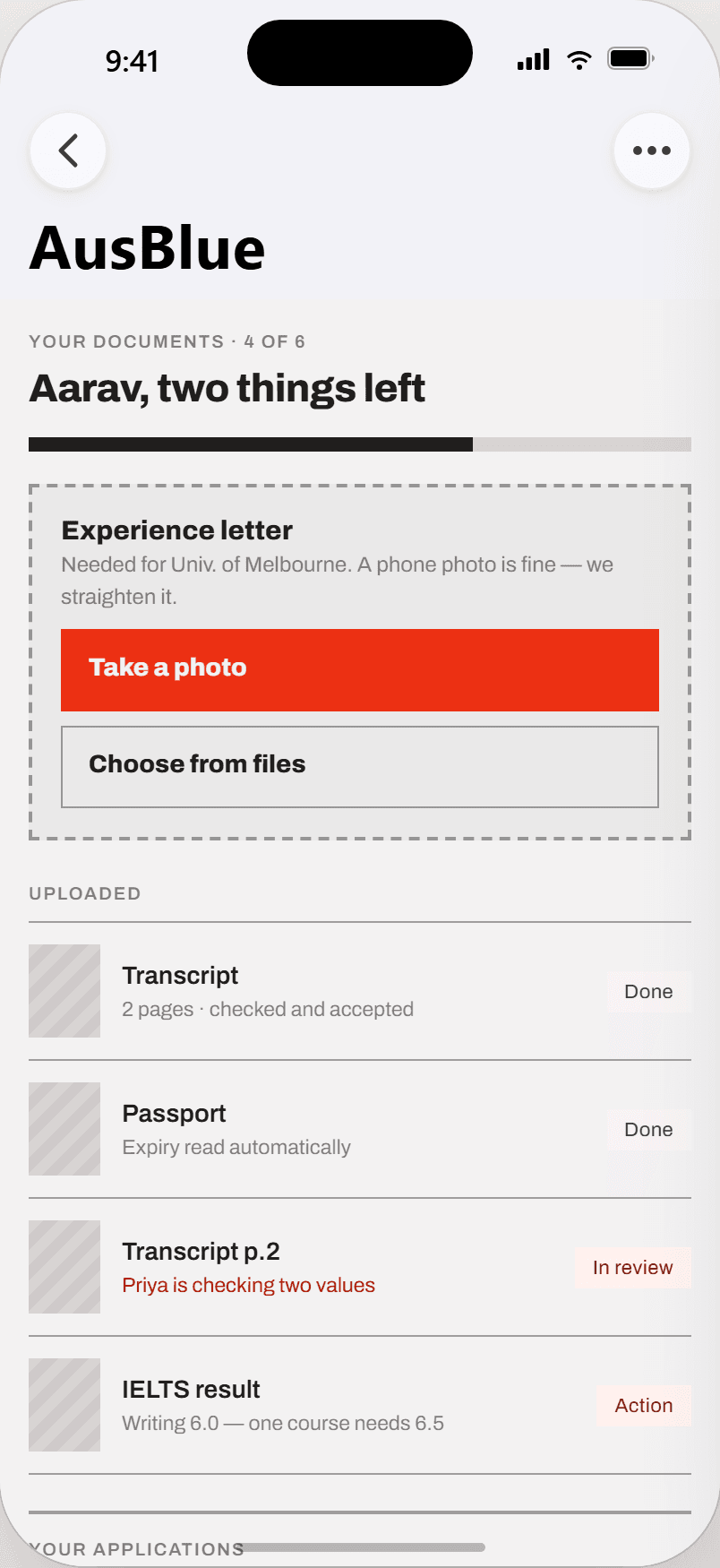
Every student arrived at AusBlue as a folder of scans — transcripts, passports, language results, experience letters, much of it photographed on a phone at an angle. Processing one student's documents took 74 minutes of counsellor time before any actual advice was given. Counsellors retyped the same details into a different form for every university — an average of 3.2 applications per student — and checked entry requirements from memory. Status lived in a shared spreadsheet only as current as its last editor. Each counsellor managed 19 applications a month, 38 deadlines were missed across the year, and 9.4% of student records were duplicates created when the same person entered through both a counsellor and a sub-agent. Fourteen times a year, a student was submitted to the same university twice.
Approach
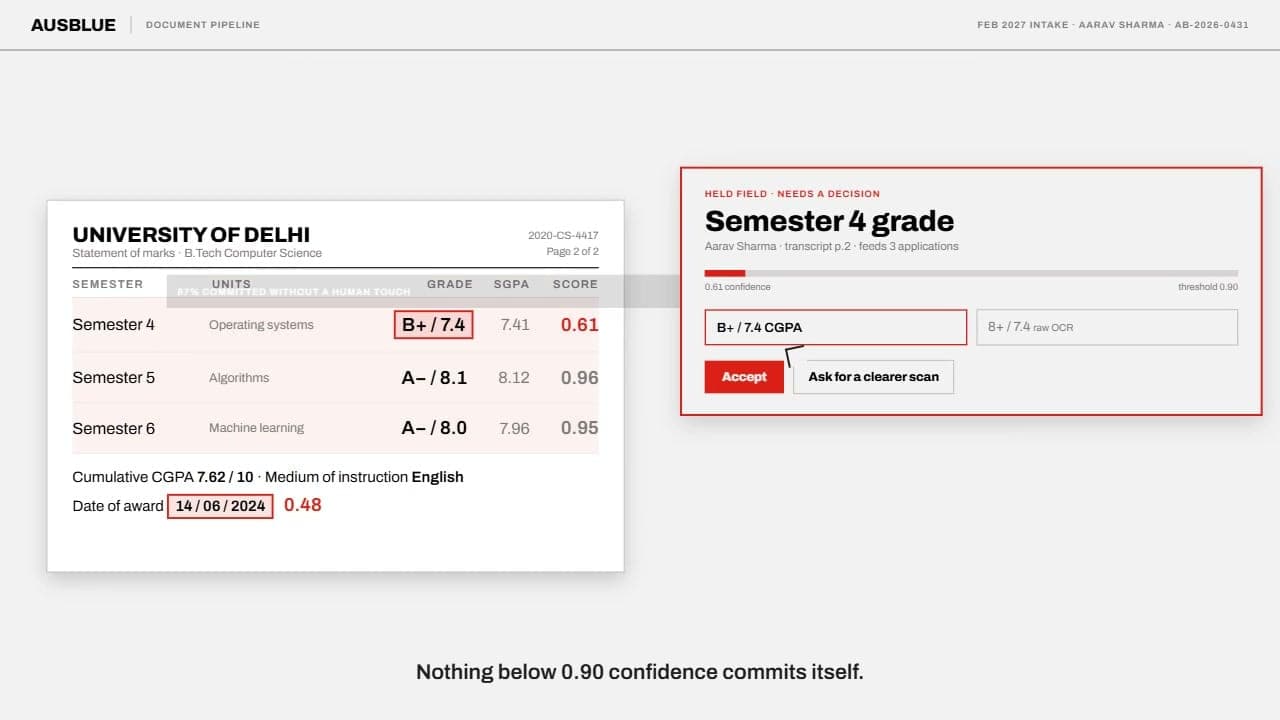
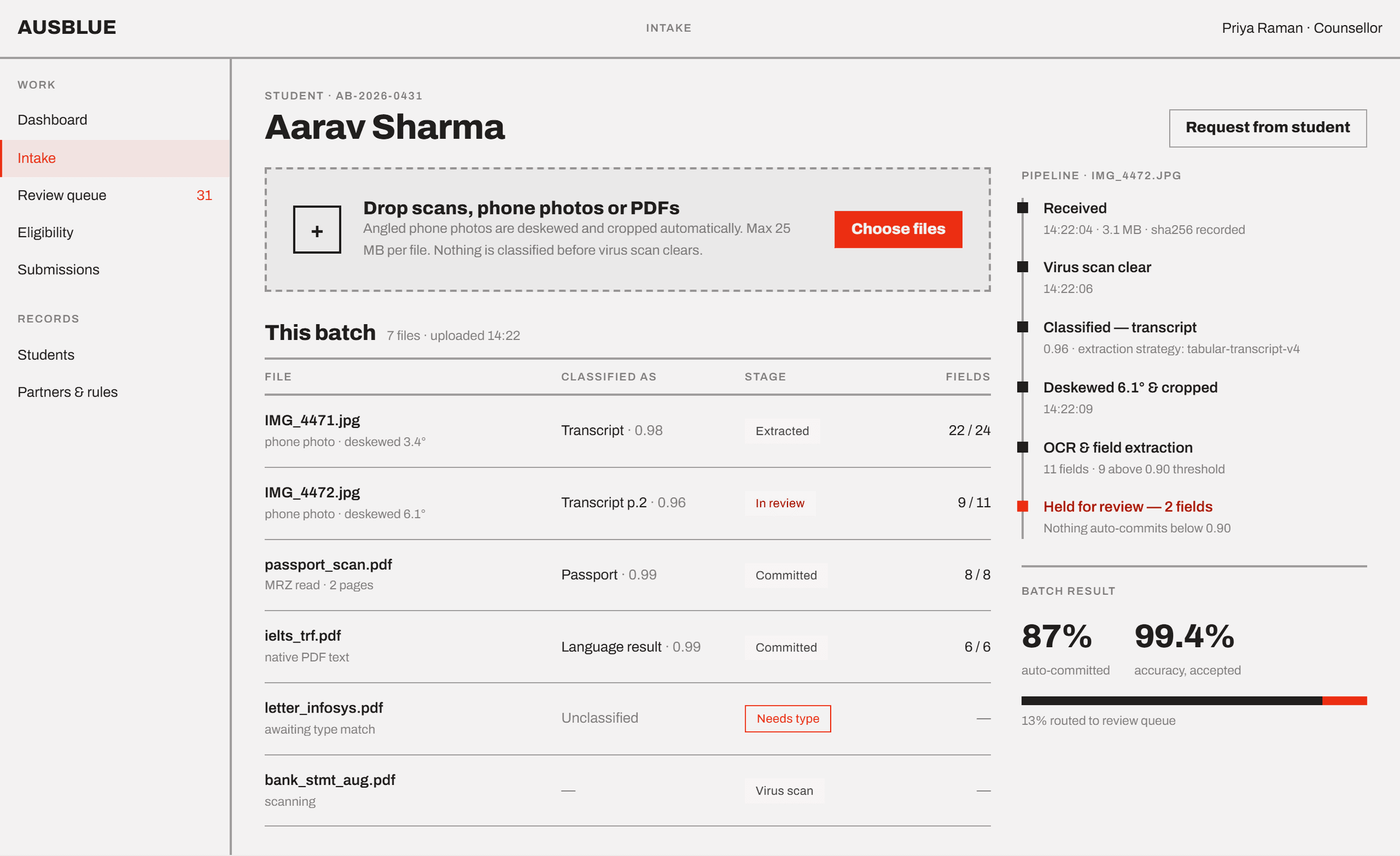
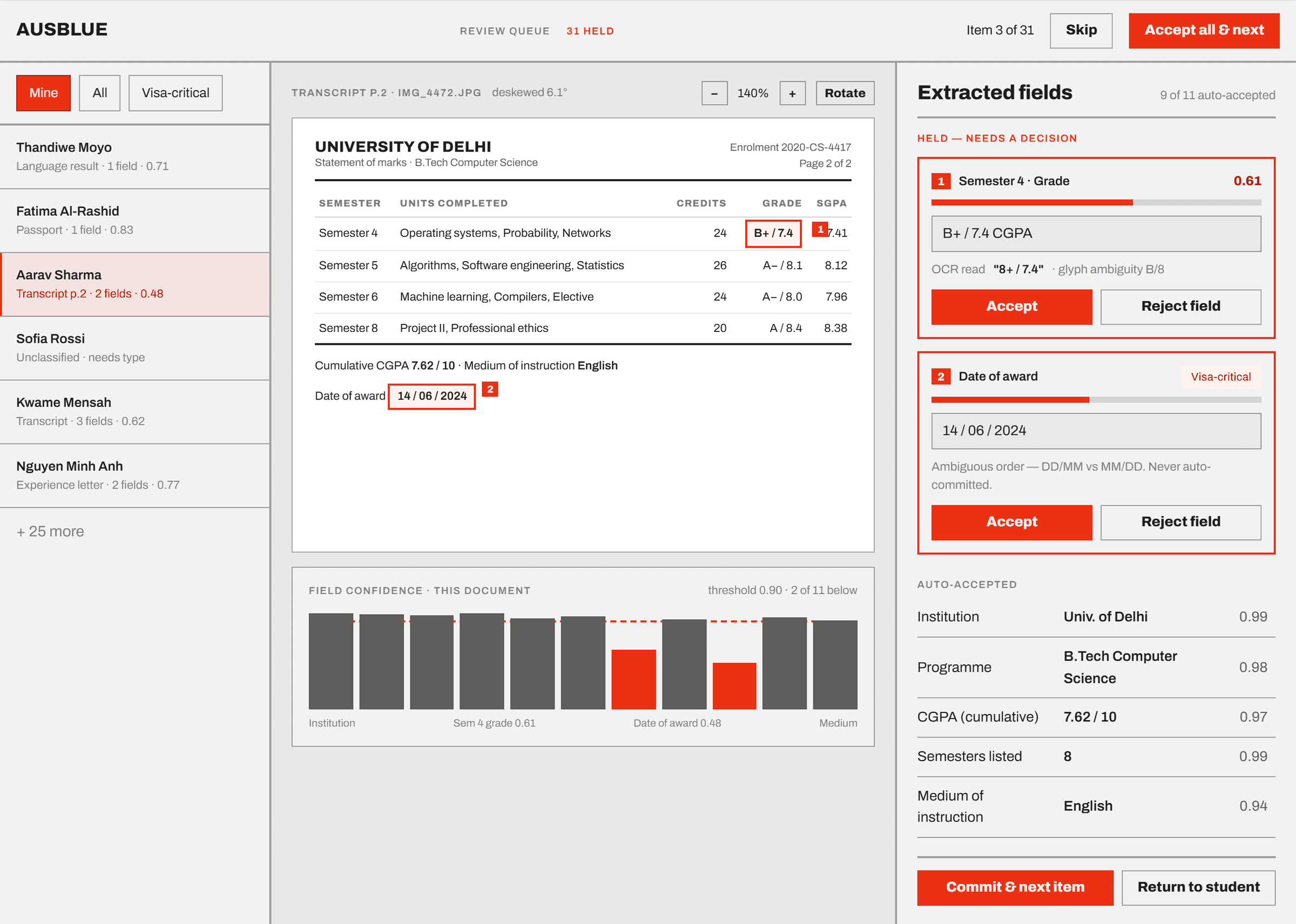
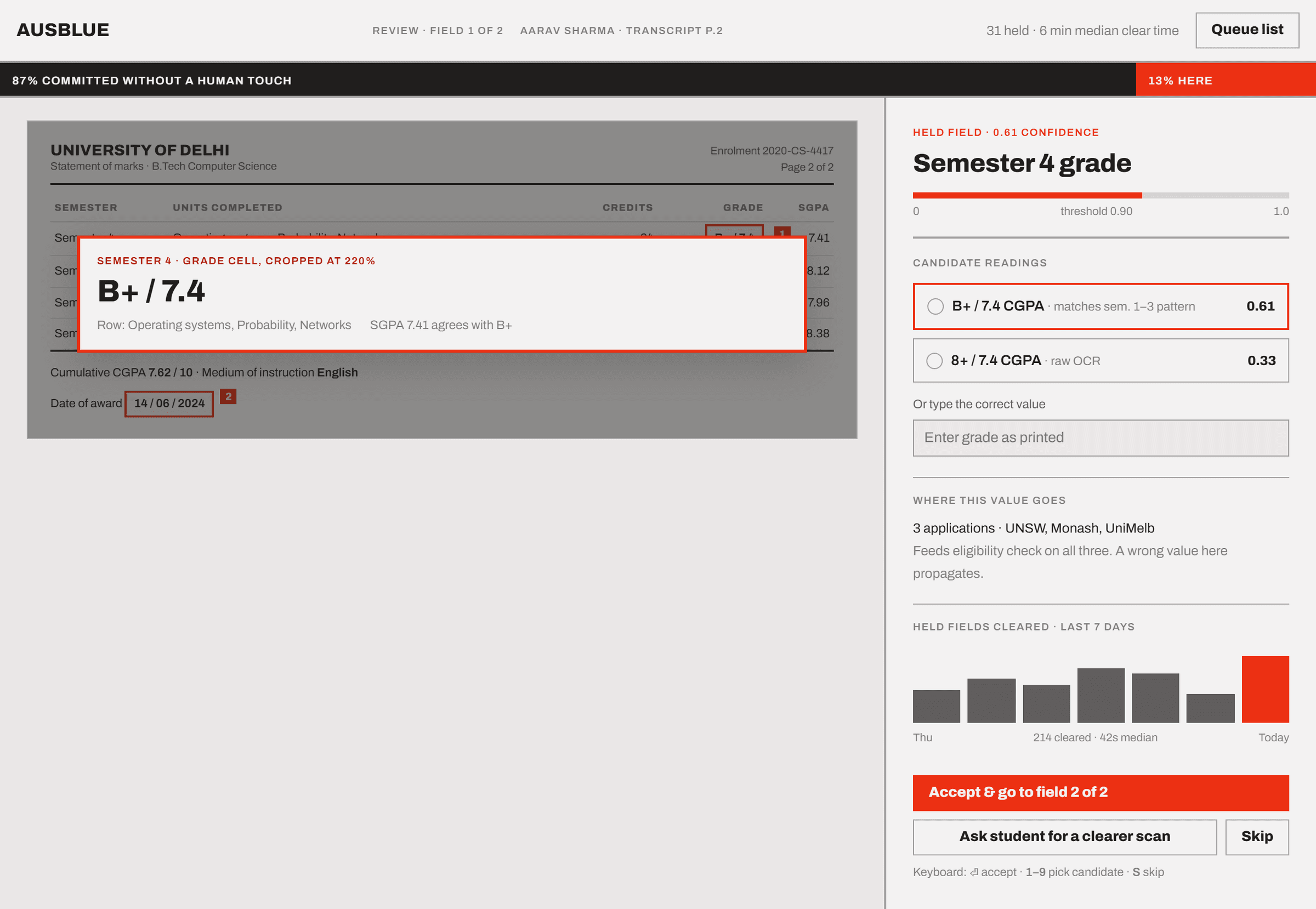
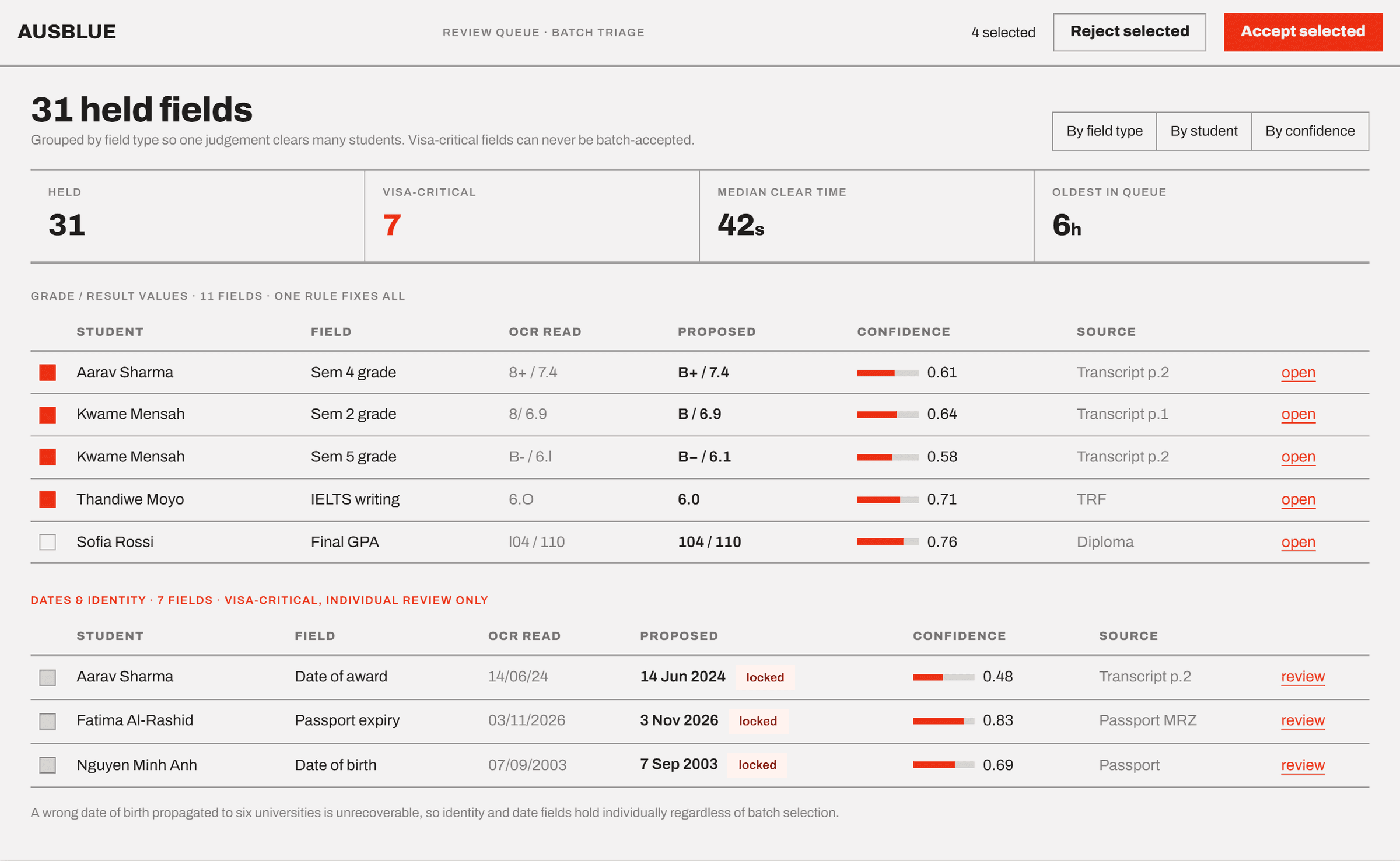
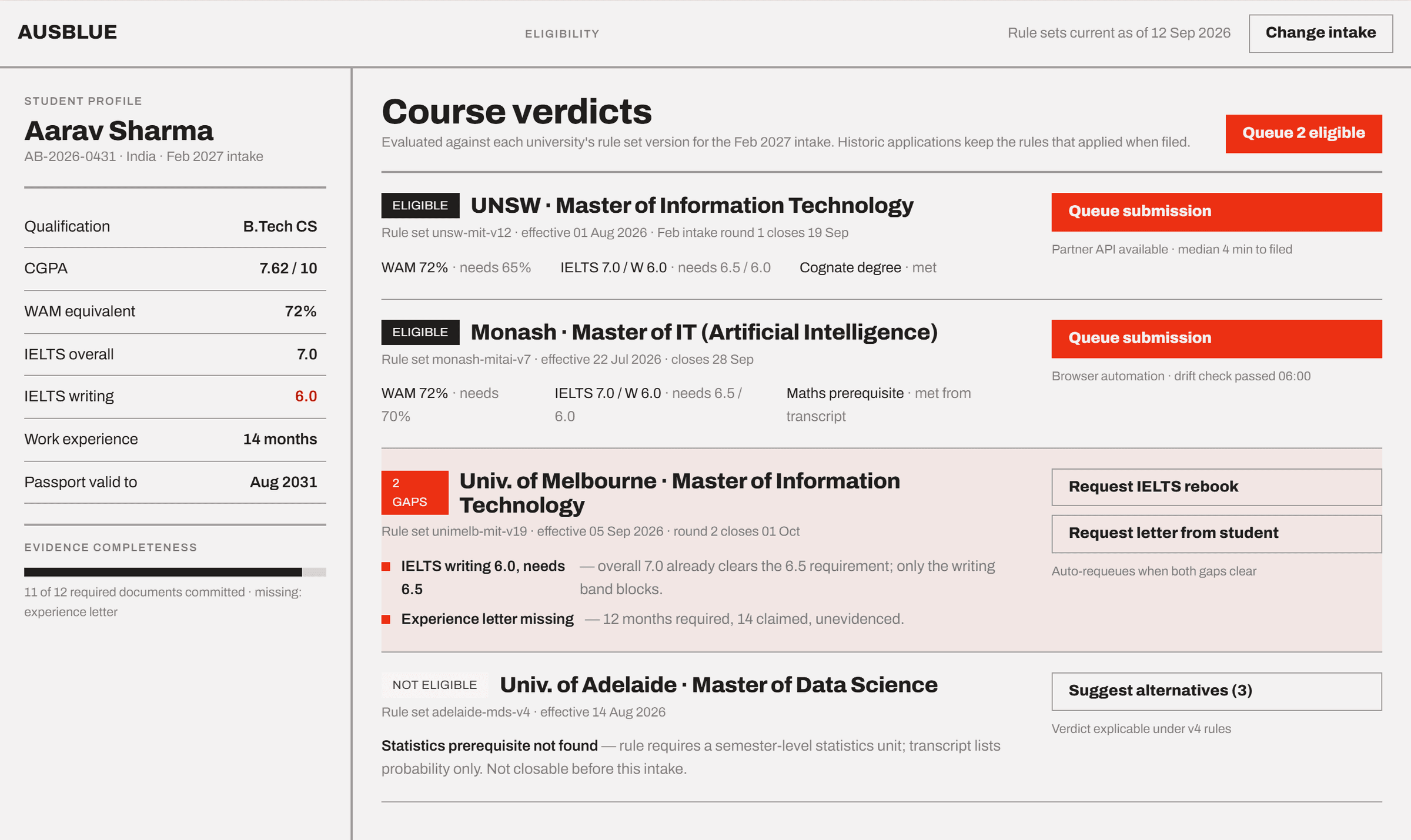
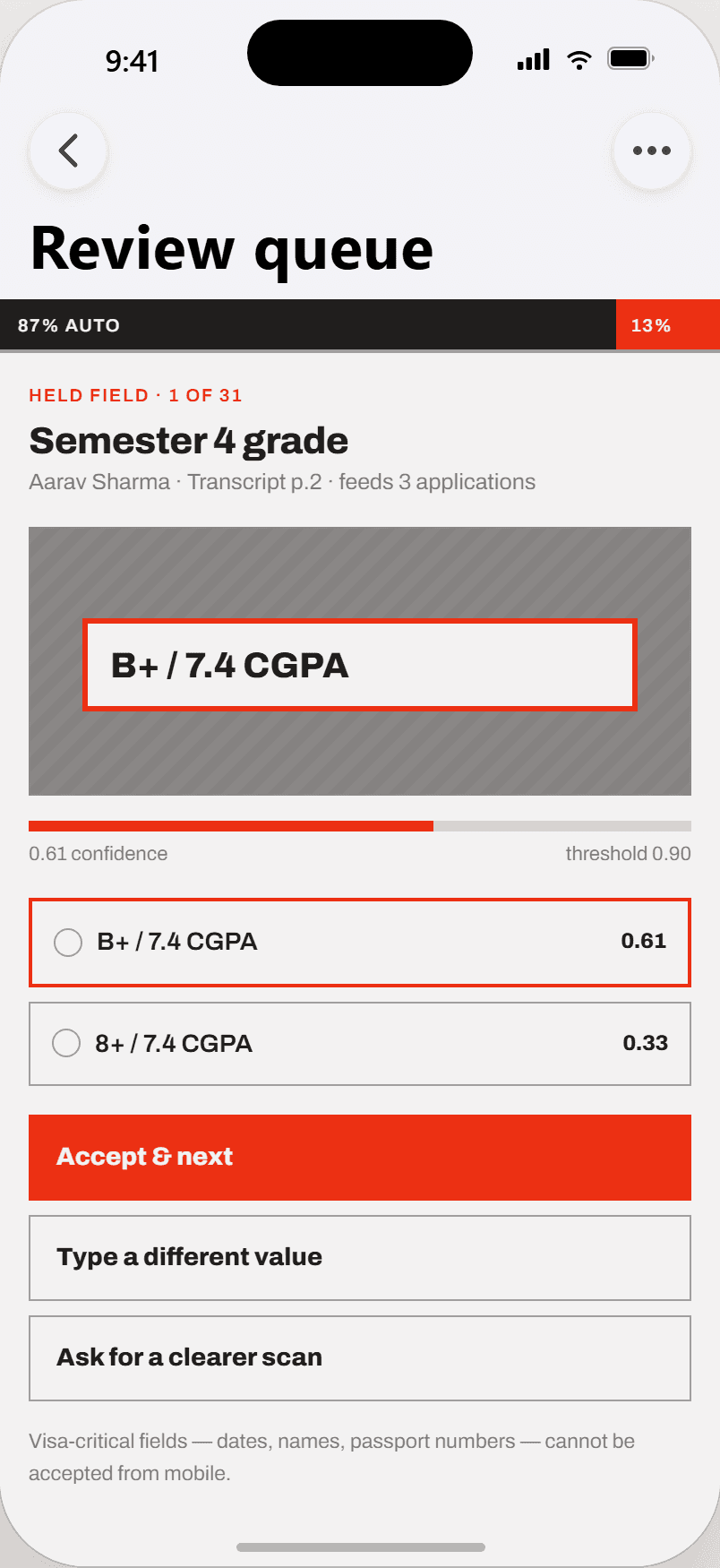
We treated document intake as a pipeline problem, not an upload-form problem. A file lands, gets virus scanned, then classified by type, because the extraction strategy for a transcript differs from a passport; phone-photo images are deskewed and cropped before OCR, and every extracted field comes back with a confidence score. Nothing auto-commits on low confidence — that single design decision is why the system can be trusted with visa-critical data, since a wrong date of birth propagated to six universities is an unrecoverable error. Entry requirements were modelled as versioned rule sets per university and course rather than code, because requirements change between intakes and a historic application has to remain explicable under the rules that applied when it was filed.
Solution
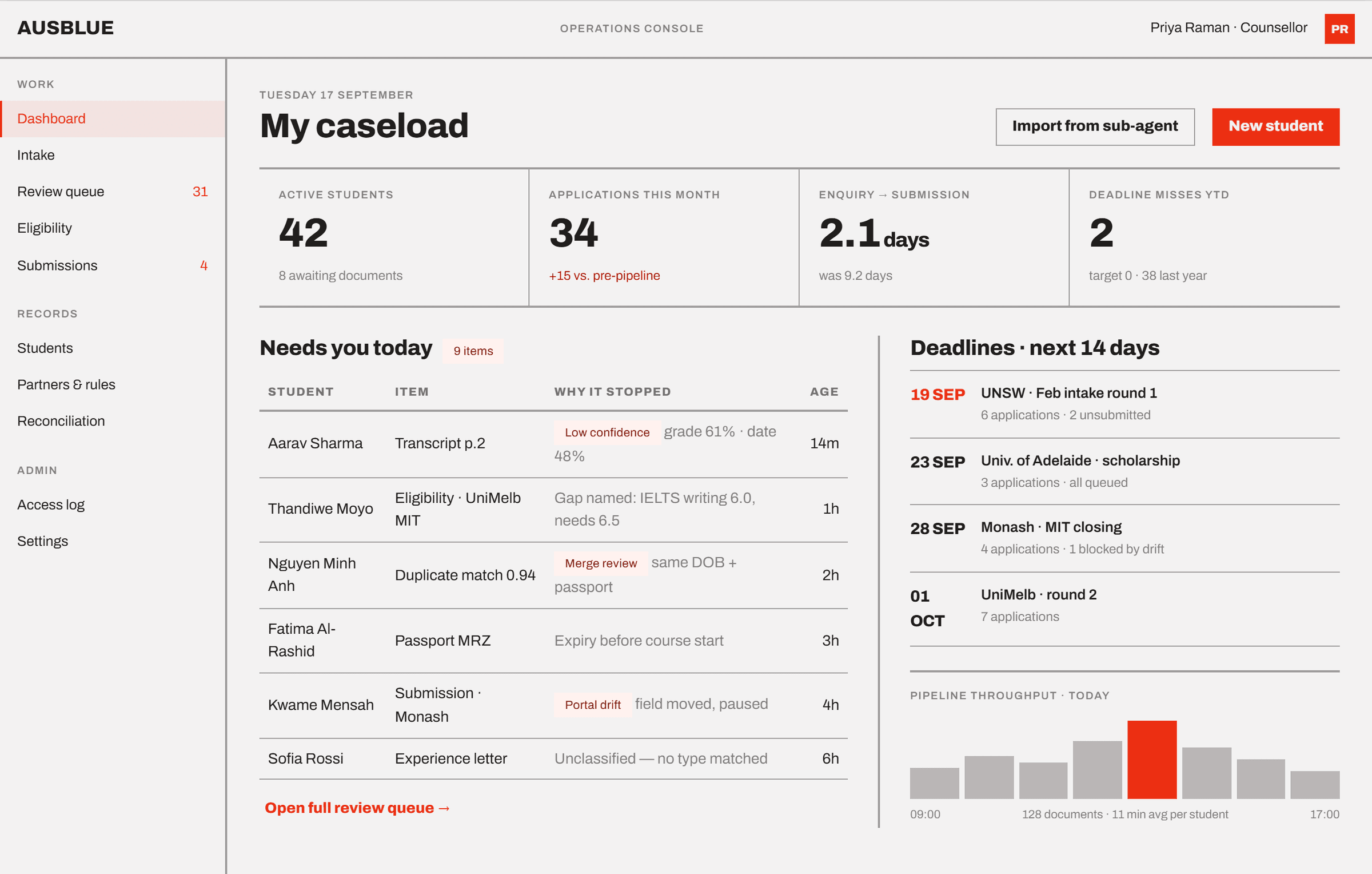
Eighty-seven per cent of fields now commit without a human touching them, at 99.4% accuracy on accepted fields; the remaining 13% route to a review queue. The eligibility engine evaluates a student profile against the current rule set and returns a verdict with the specific gaps named — "IELTS writing 6.0, needs 6.5" rather than a bare rejection. Submission runs as a queue of durable, idempotent jobs keyed on a submission key, so a retry after a timeout cannot file the same student twice; double submissions went from 14 a year to zero. Where a partner exposes an API we use it, where they don't submission runs through browser automation against their portal, with structural drift monitoring that alerts before a whole intake's submissions fail silently — six drift events were caught in the first year, protecting roughly 180 queued applications. Every successful submission stores a screenshot and response payload as evidence. Fuzzy matching on name, date of birth, and passport with a merge review step took duplicate student records from 9.4% to 0.6%. Documents live in a versioned vault with an immutable access log, explicit consent capture, and configurable data residency.
Results
Enquiry to first submitted application
9.2 days→2.1 days
Document processing per student
74 min→11 min
Fields captured without typing
0%→87%, at 99.4% accuracy on auto-accepted fields
Applications per counsellor per month
19→34
Offer rate
44%→53%
Deadline misses
38/year→2
Duplicate student records
9.4%→0.6%
Double submissions
14/year→0
Commission reconciliation lag
3 weeks→live
Annual value USD $230,800 (additional enrolments from offer-rate improvement, recovered missed-deadline value, counsellor hiring avoided) against a USD $110,000 build and USD $43,200 annual running cost — 7.0-month payback
Product Screens
Ready to Build Something Great?
Book a free strategy session and get a tailored roadmap from our experts — no commitment required.